Posts

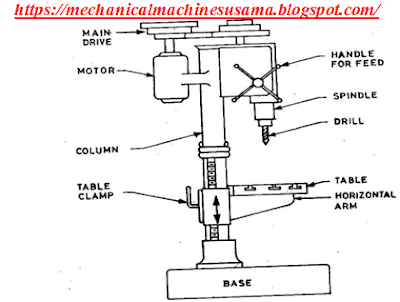
Study of major parts of Upright Drill Machine
Image
  Base:              The base is that part of a machine on which the column is mounted.   Column: The column is the most important part which is mounted on the base and acts as a support and holding device for all the other parts of an upright drilling machine. It acts as a support for table and all feed mechanisms. Table:           Table is the part on which the work piece is mounted. This is held up by fixing it to a column. A table can have rectangular geometry or circular in shape. Slots are provided on the table for holding the work piece very effectively. Three types of movements of the table are provided so as to achieve the centering very easily. The three movements incorporated in the table are   ·    Vertical adjustment ·    Radial adjustment around the column   ·   Circular adjustment about its own ...

Study of Operations Performs by Dril Machine

Image
Reaming: It is the operation of sizing and finishing a hole by means of a reamer having several cutting edges. Boring: It is the operation of enlarging a hole by means of an adjustable cutting tool with only one cutting edge. Counter Boring: It is the operation of enlarging the end of a hole cylindrical, in order to accommodate the screw head so that it does not protrude outside. Counter Sinking: It is the operation of a cone- shaped enlargement of the end of a hole. Spot Facing: It is the operation of smoothing and squaring the surface around a hole, as for the seat for a nut or the head to a cap screw. Tapping: It is the operation of forming internal threads by means of a tool called a tap.

Introduction to a Drill Machine

Image
Drill Machine: Drilling  is a process of making hole or enlarging a hole in an object by forcing a rotating tool called  Drill . The same  operation  can be accomplished in some other  machine  by holding the  drill  stationary and rotating the work. A   drill   is a   tool   fitted with a   cutting tool   attachment or driving tool attachment, usually a   drill bit   or   driver bit , used for   boring   holes in various materials or   fastening   various materials together with the use of fasteners. The attachment is gripped by a   chuck   at one end of the drill and rotated while pressed against the target material. The tip, and sometimes edges, of the cutting tool does the work of cutting into the target material. This may be slicing off thin shavings ( twist drills   or   auger bits ), grinding off small particles ( oil drilling ), crushing and rem...

Operations Performs on Lathe Machine

Image
Facing Facing is the process of removing metal from the end of a workpiece to produce a flat surface. Most often, the workpiece is cylindrical, but by using 4- jaw chuck we can face rectangular or odd-shaped work to form cubes and other non-cylindrical shapes. When a lathe cutting tool removes metal it applies considerable tangential (i.e. lateral or sideways) force to the workpiece. To safely perform a facing operation the end of the workpiece must be positioned close to the jaws of the chuck. The workpiece should not extend more than 2-3 times its diameter from the chuck jaws unless a steady rest is used to support the free end. Straight turning In this operation the work is held in the spindle and is rotated whole the tool is fed past the work piece in a direction parallel to the axis of rotation. The surface generated is a cylindrical surface. Taper Turning A taper may be defined as a uniform increase or decrease in diameter of a work piece measured along its length...

Main parts of Lathe Machine

Image
          The Bed:                     The lathe bed is a mounting and aligning surface for the other machine components. Viewed from the operating position in front of the machine, the headstock is mounted on the left send of the bed and the tailstock on the right. The bed must be bolted to a base to provide a rigid and stable platform. 1        Head Stock:            The head stock is the part of the lathe which serves as a housing for the driving pulleys and back gears, provides bearing for the machine spindle and keeps the latter in alignment with the bed. It is a fixed part which will present on the left side of the lathe bed. Head stock will consists of a hollow spindle and drives unit like main spindle, feed reverse lever, live center cone pulley etc., The tapered bar with pointed or projected end is going to grip the work piece ...

Introduction to a Lathe Machine

Image
A   lathe   is a   machine   tool which rotates the work piece on its axis to perform various operations such as cutting, sanding, knurling, drilling, or deformation, facing, turning, with tools that are applied to the work piece to create an object which has symmetry about an axis of rotation.or The lathe is a machine tool used in metal cutting operations called "turning." The work piece is rotated as tooling is applied to it to remove material.  Lathes can be manually operated or operated by computer numerical control (CNC). The lathe bed is a mounting and aligning surface for the other machine components. Viewed from the operating position in front of the machine, the headstock is mounted on the left end of the bed and the tailstock on the right. The bed must be bolted to a base to provide a rigid and stable platform.